Estate Planning Costs and Process in Australia: What to Expect, Step by Step

Estate planning in Australia usually involves an initial meeting, a review of your assets and family, tailored advice, drafting your will and related documents, and a formal signing. Cost depends on complexity: assets, blended families, business interests, trusts and the risk of a family provision claim. A good lawyer can give you a clear fee estimate upfront.
Most people we meet already know they need a will. What they are unsure about is everything around it: what estate planning actually covers, what the process involves, and whether a will kit would do the job for a fraction of the price. Those are fair questions, and they deserve straight answers.
This guide walks you through what professional estate planning includes, how the process unfolds, what drives the fee, and where DIY documents tend to fall over. We have deliberately not quoted dollar figures. Every family is different, and a number that suits one household would mislead another. Instead, we explain the factors so you can ask the right questions and request a fee estimate that fits your circumstances.
Key Takeaways
- Estate planning is more than a will. It usually includes an enduring power of attorney, guardianship wishes for children and superannuation nominations.
- The process is manageable: a meeting, some information gathering, advice, drafting, a review and a signing.
- Fees reflect advice and risk management, not just document preparation. Complexity is the main driver.
- A will does not control everything. Super, jointly held property and company or trust assets often pass outside it.
- Will kits can work for very simple situations, but errors are common and fixing them after death is usually far more expensive than getting it right first.
- You can ask for a clear, upfront fee estimate before you commit to anything.
Summary: The Estate Planning Process at a Glance
| Stage | What happens | How it affects the fee |
|---|---|---|
| Initial meeting | We listen to your family, assets and concerns | Usually the starting point for a fee estimate |
| Information gathering | You provide details of assets, debts, super and structures | Messy or complex records mean more work |
| Advice | We explain your options and the risks of each | Blended families, trusts and businesses need more advice |
| Drafting | Your will and related documents are prepared | More tailored clauses mean more drafting |
| Review | You read the drafts and we adjust them | Changes of mind add time |
| Signing and witnessing | Documents are signed correctly and stored safely | Generally straightforward |
What Does Estate Planning Actually Include?
 Estate planning is the set of legal documents and decisions that govern who looks after you if you lose capacity, and who receives your assets when you die. A complete plan typically covers a will, an enduring power of attorney, guardianship wishes for minor children and superannuation nominations.
People often use "will" and "estate plan" interchangeably. They are not the same thing. A will is one document inside a broader plan, and a plan that stops at the will leaves real gaps.
Your will
Your will says who gets what, who manages your estate and who cares for your children if you both die while they are young. It names your executor, the person who collects your assets, pays debts and distributes the rest. Our separate guidance on executor duties and estate administration explains what that role involves, and it is worth thinking carefully about who you ask.
Enduring power of attorney
An enduring power of attorney lets someone you trust make financial and legal decisions if you cannot. A will only operates after death. If you have a stroke or develop dementia, your will does nothing. Without an enduring power of attorney, your family may need to apply to a tribunal or court for authority to manage even simple things like selling a house or accessing a bank account.
The names and rules differ between states and territories. Medical and lifestyle decisions are often dealt with in a separate document, sometimes called an enduring guardianship or advance care directive. We explain which documents apply to you based on where you live.
Appointment of guardian
If you have children under 18, your will can state who you would want to care for them. A court makes the final decision based on the children's best interests, but your wishes carry real weight. Having them in writing gives your family a clear starting point at a very hard time.
Superannuation nominations
For many Australians, super is one of the largest assets they own, and it usually does not form part of the estate. A binding death benefit nomination tells your fund who must receive your super when you die, subject to the fund's rules and the law. Without a valid nomination, the trustee generally decides who is paid, within the limits of the legislation.
Super is a good example of why estate planning is a system, not a single document. Your will might say one thing while your nomination says another. We make sure they work together.
How Does the Estate Planning Process Work, Step by Step?
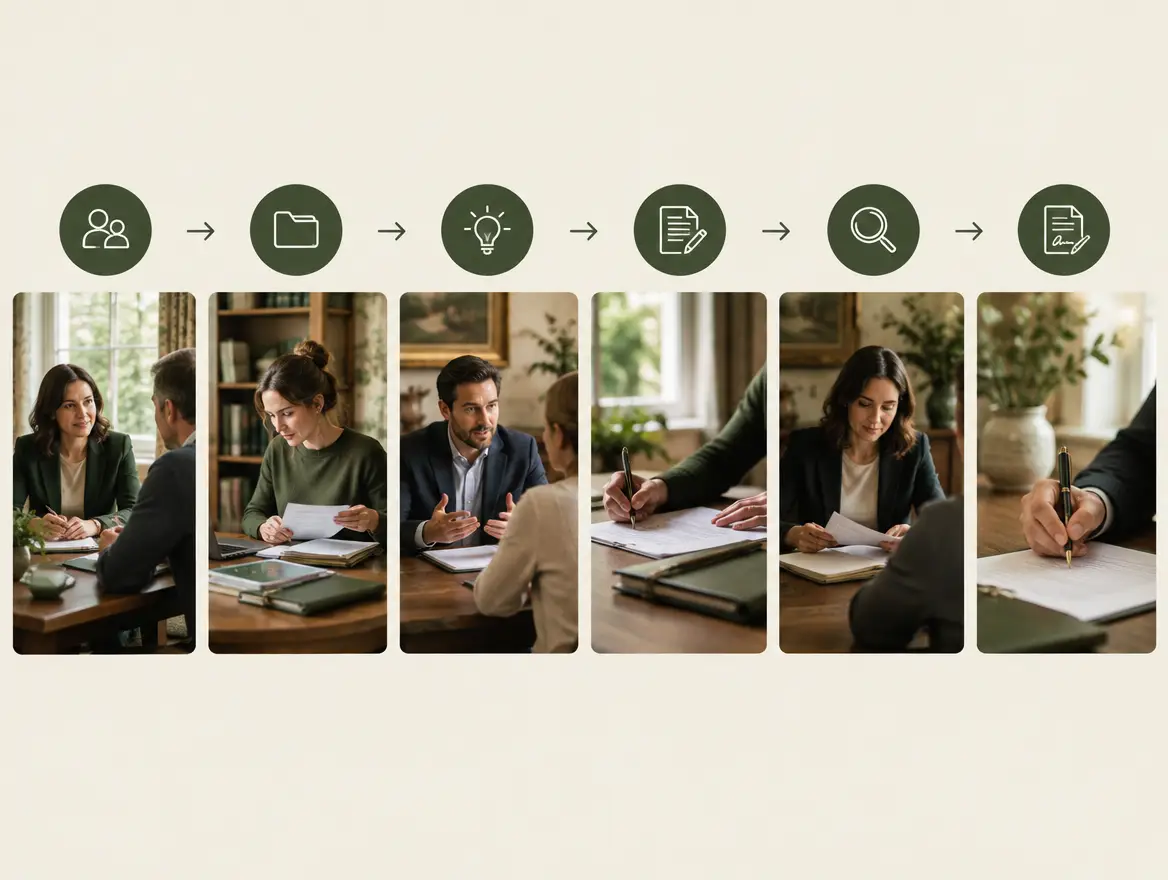 The process runs in six stages: an initial meeting, gathering information, advice, drafting, review, and a formal signing. It is far less daunting than most people expect. You do the thinking and provide the facts, and we handle the legal structure and the paperwork.
Step 1: The initial meeting
We start by listening. Who is in your family? Who do you want to look after? Is there anyone you are worried about? We ask about your home, super, savings, investments, debts and any business interests. There are no wrong answers, and you do not need to arrive with a finished plan.
This is also the point where you can ask for a fee estimate. A reputable firm should be able to tell you what is involved and how the fee is likely to be calculated once they understand your situation.
Step 2: Gathering asset and family information
Next we collect the details. That generally includes property titles, how each property is owned, super fund details, any existing nominations, company and trust documents, and any previous wills. We also want to know about previous relationships, children from earlier relationships, and anyone who depends on you financially.
It is common to discover small surprises here. A property might be held as joint tenants when you assumed tenants in common, or an old super nomination might name an ex-partner. Finding these now is far cheaper than finding them after a death.
Step 3: Advice
This is the stage that separates legal advice from a form. We explain your options, the risks attached to each and how they interact. For example, leaving your home to your second partner for life with the remainder to your children can seem fair, but it creates a long-term relationship between people who may not get along. We talk through whether that arrangement is realistic.
We also consider whether a testamentary trust makes sense for you. These trusts, created by your will and operating after death, can offer protection and flexibility for beneficiaries. They are not right for everyone, and we only recommend them where they add real value.
Step 4: Drafting
Once the plan is clear, we draft your documents. Drafting is where precise legal language matters. A clause that reads naturally to a layperson can be ambiguous to a court. Our drafting aims to say exactly what you mean, in a way that holds up if someone challenges it.
Step 5: Review
You read the drafts, ask questions and tell us what needs to change. We encourage you to take your time. Reading a draft often prompts new thoughts, and it is much easier to adjust a draft than a signed will.
Step 6: Signing and witnessing
A will must meet formal requirements to be valid. In general it must be in writing, signed by you, and witnessed by two adults who watch you sign and who are not beneficiaries. Rules vary by state, and getting this wrong can invalidate the document. We supervise the signing, confirm everyone understands what they are signing, and arrange safe storage of the originals.
Steven Clark is actively involved in supervising operations and overseeing standards of work, so the documents that leave our office have been prepared and checked to a consistent standard.
What Affects the Cost of Estate Planning?
Estate planning fees are driven mainly by complexity. The more assets, relationships, structures and risks involved, the more advice and drafting is required. A simple plan for a couple with one home and aligned wishes costs less than a plan covering a blended family, a business and several trusts.
We do not quote figures in this article because any figure would be a guess about your life. What we can do is explain the factors, so nothing about your fee estimate comes as a surprise.
Complexity of your assets
Owning a home and a super account is one thing. Owning investment properties, shares, a self-managed super fund, overseas assets or valuable collectables is another. Each additional asset type raises questions about how it is owned, how it will be dealt with and what tax or administration issues might arise.
Blended families
Blended families are where estate planning most often goes wrong, and where advice matters most. You may want to provide for a new partner while protecting your children from a first relationship. Those goals can pull against each other. Working out a fair structure takes careful conversation and more detailed drafting.
Business interests
If you own a business, or part of one, your plan must consider what happens to it. Who takes over? Who is paid out? Do partnership or shareholder agreements override your will? Succession planning for a business is a legal and commercial exercise, and it adds meaningfully to the work involved.
Trusts and company structures
Family trusts and companies are often assumed to be covered by a will. Usually they are not. Control of a trust generally depends on the trust deed and who is the appointor or trustee. If that is not dealt with, control of your family's wealth may not pass the way you expect. Reviewing and aligning these structures takes time and legal skill.
Risk of family provision claims
In Australia, eligible people can apply to a court to challenge a will if they believe they have not been adequately provided for. Who is eligible, and the time limits, vary by state. If you intend to leave someone out or give them less than they might expect, a well-planned strategy can reduce the risk of a successful claim. That planning is part of what you are paying for.
Why the fee reflects advice, not just paperwork
Printing a will takes minutes. What you are paying for is the experience to ask the right questions, spot the risks and structure your affairs so they work when you are no longer there. A lawyer is also accountable for the advice and carries professional indemnity insurance. A form carries none of that.
We are happy to give you a clear fee estimate before you commit. If your situation is simple, we will tell you so.
Will Kit vs Lawyer: What Are the Risks of Going It Alone?
A will kit can be adequate for a very simple estate, such as a single person with modest assets and no dependants. For most people with a home, super, children or a blended family, the risk is not the price of the kit. It is the cost and conflict of fixing errors after you have died.
We do not say this to dismiss people who use kits. Many do so because they want to act quickly, and doing something is better than doing nothing. But there are patterns we see repeatedly.
Common will kit mistakes
- Invalid signing or witnessing. A missing witness, a beneficiary acting as a witness or a signature in the wrong place can undermine the whole document.
- Ambiguous wording. Phrases like "my savings" or "my share of the house" can be interpreted in different ways.
- Ignoring how assets are owned. Leaving a jointly held property to someone in your will has no effect if the property passes automatically to the surviving owner.
- Forgetting about super. The will says one thing, the fund pays someone else.
- No backup plan. If a beneficiary dies before you, or an executor cannot act, the will may not say what happens next.
- No consideration of claims. Kits do not assess whether someone could challenge your will.
- Outdated documents. Kits are rarely revisited after a marriage, separation, birth or death.
Moneysmart, the consumer guidance service run by ASIC, encourages Australians to think about wills and estate planning as part of managing their money, and notes that more complex circumstances warrant professional help.
The cost of fixing it later
When a will is invalid or unclear, the cost does not disappear. It shifts to your family. They may need court proceedings to interpret the document, or to have an informal document recognised. Legal costs in contested estates can be considerable and are often paid from the estate itself, which reduces what the beneficiaries receive. The emotional cost is harder to measure but just as real.
An illustrative scenario
Consider a hypothetical couple in their fifties. Each has adult children from a first marriage, and they have since married each other and bought a home together. Years earlier, one of them completed a will kit, leaving everything to their children. They never updated it, and they never thought about how the home was owned.
If the home is held as joint tenants, it passes straight to the surviving spouse, regardless of the will. The children of the first spouse to die may receive nothing from the main asset. The surviving spouse may then leave everything to their own children. The first family is effectively cut out, and a dispute becomes likely.
This is not a story about bad people. It is a story about a document that was never matched to the family it was meant to protect. A conversation at the planning stage would have flushed out the issue immediately.
What Assets Does a Will Not Control?
A will only controls assets held in your sole name. Superannuation, jointly held property and assets owned by companies or trusts generally pass according to other rules. If your estate plan ignores them, your will may govern far less than you think.
This is the part of estate planning that surprises people most. Many assume "my will covers everything I own". It often does not.
Superannuation
Super is held by a trustee, not by you personally. When you die, the trustee pays the death benefit according to the fund's deed, the law and any valid nomination. A binding death benefit nomination can direct payment to your dependants or to your legal personal representative, which means the money flows through your estate and is governed by your will. Funds have their own rules on how long a nomination stays valid and how it must be signed, and some offer non-lapsing nominations. Check yours.
There are also tax consequences, depending on who receives the benefit. The Australian Taxation Office publishes guidance on how super death benefits are taxed, and we recommend you also speak to your accountant or financial adviser.
Jointly held property
When you hold property as joint tenants, the survivor takes the whole property automatically when one owner dies. This is called the right of survivorship, and it overrides your will. If you hold property as tenants in common, each owner holds a distinct share which can be left by will. Many couples do not know which they have. We check the title.
Company and trust assets
Assets owned by a company or trust do not belong to you personally. Shares in a company may form part of your estate, but the company's assets do not. Trust assets are controlled by the trustee under the trust deed, and control often passes by the appointor mechanism rather than by your will. If you rely on a family trust or company, your estate plan must be built around those structures.
After death: administration
Even with a good plan, the estate must be administered. In many cases an executor must apply to the court for a grant of probate. If there is no valid will, a person may apply for letters of administration instead. Intestacy rules, which decide who inherits when there is no will, differ between states and territories, so the outcome depends on where you live. Public trustee offices and law societies regularly remind Australians that dying without a valid will can leave families with outcomes that nobody intended.
How Do You Keep Your Estate Plan Current?
You should review your estate plan after major life events such as marriage, separation, a birth, a death, a significant change in assets or a move interstate. An outdated plan can be as risky as no plan. Updating is usually simpler than starting again.
The effect of marriage, divorce and separation on an existing will varies between states, and separation in particular can leave a will pointing to someone you no longer want to benefit. Our separate guidance on updating or revoking a will explains how to do it correctly, and our family law team can advise on how separation interacts with your estate plan.
Request a Clear Fee Estimate
The simplest way to find out what estate planning will cost you is to ask. At an initial consultation we listen to your circumstances, explain what is involved and give you a clear, upfront fee estimate tailored to you. You will know what you are paying for before you decide anything.
If you would like to talk it through, book an initial estate planning consultation with Steven M Clark. There is no pressure and no jargon.
Why a Cheap Document Is Not the Same as a Cheap Outcome
The most valuable part of estate planning is not the document. It is the conversation that happens before the document is written. Our position is that a fee spent on asking the right questions is the best-value part of the whole exercise.
When we sit down with a family, the paperwork is rarely the hard bit. The hard bit is the question nobody has asked out loud. What happens to the family home if you die before your partner? Who do you trust to make decisions if you cannot? Is there a child you worry about? Would your wishes survive a challenge?
A form cannot ask those questions, because a form does not know your family. It cannot notice that the answer you give in one section contradicts another, or that the way you hold your property defeats the wish you have just described. A lawyer can.
That is why we think about the fee differently. You are not paying for a will. You are paying for someone whose job is to imagine how your plan could fail, and to design it so it does not. The cost of that imagination is small compared with the cost of finding out the hard way, and the person who pays for the discovery is usually your family, not you.
We also believe a client is entitled to understand the fee before they commit. You should know the basis of the estimate, what it includes and what might change it. If anyone is reluctant to explain that, ask why.
References
Frequently asked
Questions about this
How much does estate planning cost in Australia?
The cost depends on your circumstances. Simple plans with straightforward assets and aligned wishes generally cost less than plans involving blended families, business interests, trusts or a risk of family provision claims. The best approach is to book a consultation and ask for a clear fee estimate based on your situation.
Is a will kit enough, or do I need a lawyer?
A will kit may suit a very simple estate. If you own property, have super, have children from more than one relationship or run a business, the risk of errors rises sharply. Mistakes in signing, wording or asset ownership can invalidate your wishes and lead to costly disputes.
What is the difference between a will and an enduring power of attorney?
A will takes effect when you die and deals with your estate. An enduring power of attorney takes effect while you are alive, if you lose capacity, and lets a trusted person manage your financial and legal affairs. You need both, and medical decisions may require a separate document depending on your state.
Does my will cover my superannuation?
Usually not. Super is held by a trustee and paid according to the fund's rules and any valid nomination. A binding death benefit nomination can direct your super to specific people or to your estate. Check your fund's rules and make sure your nomination is current and matches your will.
What happens if I die without a valid will?
Your estate is distributed under intestacy rules, which vary by state and territory. These rules follow a fixed order of relatives and may not reflect your wishes. Your family may also need to apply for letters of administration, which can add time, cost and stress.