Do I Need a Lawyer for a CTP Claim in South Australia? How Legal Costs Work

You do not always need a lawyer for a CTP claim in South Australia. A minor injury with quick recovery and only treatment costs can sometimes be handled with the insurer directly. Get advice if liability is disputed, your injury is lasting, you have lost income, or the insurer wants a quick settlement.
If you have been hurt on the road around Gawler, the Barossa or the northern Adelaide Plains, you have probably already had calls and letters you did not ask for. You have also probably seen advertising promising 'no win, no fee'. It is fair to ask whether a lawyer is worth the cost, and whether the promise is as simple as it sounds.
This article gives you a straight answer. We explain how the South Australian CTP scheme works, when you can reasonably manage a claim yourself, when advice matters, and exactly how legal costs work. We also explain why our firm does not offer 'no win, no fee' arrangements, and how we charge instead. If you want to see how our broader compensation team in Gawler approaches injury work, that page is a good starting point.
Key Takeaways
- Some minor claims, with quick recovery and treatment costs only, can reasonably be managed directly with the insurer.
- Advice matters most where your Injury Scale Value (ISV) score, fault, lost earning capacity or an early offer will decide what you receive.
- Under the ISV threshold, scores of 10 or below receive no general damages for pain and loss of enjoyment of life.
- Four licensed insurers (AAMI, Allianz, QBE and Youi) handle CTP claims, and the scheme expects notification within six months of the accident.
- The general limitation period for starting a claim is three years, so do not wait.
- We do not offer 'no win, no fee'. We give a clear written estimate of fees before any work begins.
Summary Table: Do You Need a Lawyer?
| Your situation | Is advice worth getting? | Main risk if you go alone | Sensible first step |
|---|---|---|---|
| Minor injury, quick recovery, treatment costs only | Often not essential | Missing a complication that appears later | Lodge the claim, keep every receipt and record |
| Liability disputed or partly blamed on you | Strongly advisable | Claim reduced or refused | Get advice before giving detailed statements |
| Ongoing symptoms and an ISV assessment | Advisable | Score at or below the threshold, no general damages | Gather consistent medical evidence |
| Time off work or reduced capacity to work | Advisable | Lost earning capacity undervalued | Collect payslips, tax returns and employer letters |
| Early settlement offer from the insurer | Advisable before you sign | Settlement is final | Do not sign until you understand the full picture |
| Catastrophic injury | Strongly advisable | Complex interaction of schemes and long-term needs | Contact the Lifetime Support Authority and a lawyer |
How does the South Australian CTP scheme work?
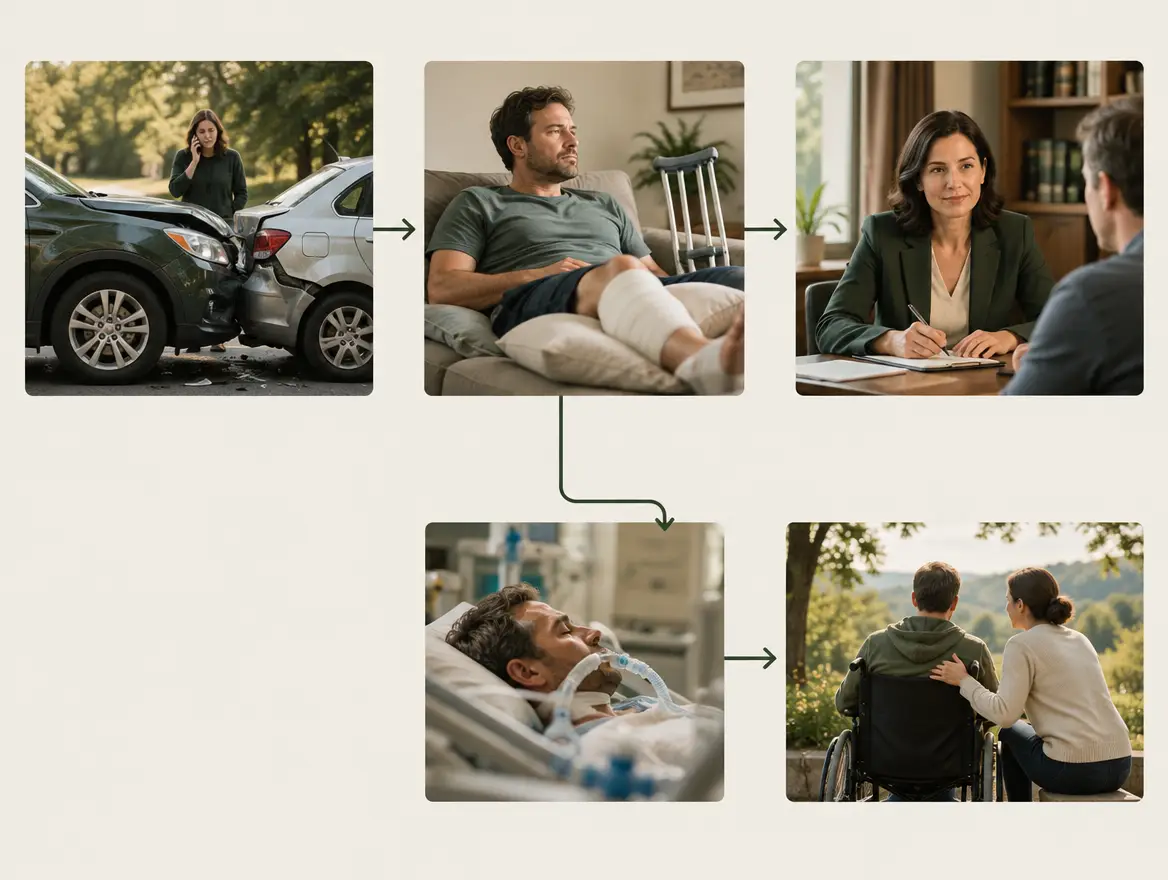
South Australia's CTP scheme compensates people injured in motor accidents caused by another driver's fault. You claim against the at-fault driver's CTP insurer, not the driver personally. Four licensed insurers compete for CTP business, and catastrophic injuries sit in a separate no-fault Lifetime Support Scheme.
Compulsory third party insurance is bought with your vehicle registration. If another driver's negligence injures you, whether you were driving, riding, cycling, walking or travelling as a passenger, your claim is generally made on that driver's insurer. Where the vehicle is unknown or uninsured, a different pathway applies, so get advice early in that situation.
The 2013 reforms and the competitive market
The scheme has been reworked more than once. The 2013 reforms, which brought in the Injury Scale Value and its threshold, and the move to a choice of licensed insurers from 1 July 2019 are the two changes that matter most to a claim today.
In practice, you may find your claim sits with AAMI, Allianz, QBE or Youi. Each is a commercial company with a claims team. Insurers must deal with claims properly, but they are also managing their own costs. That is not a criticism. It is simply the structure you are dealing with, and it is why it helps to know whose interests the person on the phone represents.
The Lifetime Support Scheme
The Lifetime Support Scheme is separate from the fault-based claim. It covers the treatment, care and support needs of people with catastrophic injuries, regardless of who was at fault. Serious brain and spinal injuries are the kind of injuries it is designed for. The Lifetime Support Authority of South Australia assesses eligibility.
If you or a family member has an injury of that kind, the questions go well beyond a single claim. Decision-making capacity, long-term care and financial management all come into play. That is where early planning, including enduring powers of attorney and guardianship, becomes important. We cover that in our Powers of Attorney guidance.
What a fault-based claim can include
A claim can include several heads of loss:
- Treatment and rehabilitation expenses.
- Past and future loss of earnings and earning capacity.
- General damages for pain, suffering and loss of enjoyment of life (the ISV component).
- Care provided by family and friends, in some circumstances.
Most disagreements with insurers arise over the second and third items. Those are also the areas where a do-it-yourself approach carries the most risk.
When might you not need a lawyer for a CTP claim?
You may not need a lawyer if your injury was minor, you have recovered quickly, liability is not in dispute and your claim is limited to treatment costs such as GP, physiotherapy or pharmacy bills. In that situation, dealing with the insurer directly can be reasonable and cost-effective.
We would rather tell you that in a short conversation than take on work that does not help you. A claim is usually manageable alone when all of the following are true:
- The injury was minor and you have fully recovered, or nearly so, with a clear medical opinion backing that up.
- You did not miss meaningful time from work and have no ongoing limits on what you can do.
- The other driver's fault is clear and the insurer has accepted it.
- Your out-of-pocket costs are limited to treatment bills you can document.
- No one is pressuring you to sign anything you do not understand.
There is also a cost logic here. If your injury is likely to score at or below the ISV threshold, there will be no general damages. The claim is then limited to economic items such as treatment costs and any lost income. For a small claim of that kind, legal fees can be out of proportion to what is at stake, and the restrictions on recoverable costs for lower-value claims (covered below) make that gap more likely.
Two cautions apply. First, injuries sometimes declare themselves late. A sore neck that settles in a fortnight is one thing. A sore neck that returns months later is another, and a settlement is final. Second, 'minor' is a judgement. If you are unsure, a single conversation costs far less than a settlement you later regret.
When does legal advice matter in a CTP claim?
Advice matters when the value of your claim depends on judgement calls you may not know you are making: how your injury is scored, who was at fault, what your future earning capacity looks like, and whether an early offer is fair. These are hard to correct once you settle.
Injury Scale Value assessments
South Australia values non-economic loss, meaning pain, suffering and loss of enjoyment of life, using an Injury Scale Value. A score is assigned to your injuries, and that score drives the general damages amount. Scores of 10 or below receive no general damages at all.
That threshold is a cliff edge. A score at the line and a score just above it can be the difference between nothing and a meaningful sum for pain and loss of enjoyment of life. The score depends on medical evidence: your GP's notes, specialist reports, and how consistently your symptoms and limits are recorded.
This is not about inflating anything. It is about making sure the evidence accurately reflects what you are living with. An insurer may rely on its own medical examiner. It helps to have someone who knows what a proper assessment needs, and who can spot where a report understates or overlooks an injury.
Disputed liability
When an insurer says you were partly responsible, your compensation can be reduced. When it says you were wholly responsible, it can be refused. Common arguments include not wearing a seatbelt, speed, a cyclist's visibility, or a pedestrian's choice of crossing point.
Consider a cyclist hit on a country road near Lyndoch who is told the driver 'didn't see them' and that the cyclist shares the blame. Whether that argument holds depends on evidence: witness accounts, vehicle damage, road conditions, and the police report. Those things are easiest to gather early, and they are hard to rebuild later. This is also where a matter can move toward formal dispute, and our Dispute Resolution and Litigation team handles that side of the work if it comes to it.
Lost earning capacity
Lost income is more than the pay you missed. It includes what your injury may cost you in future: reduced hours, a change of job, or being unable to do physical work. That is often the largest part of a serious claim.
Consider a self-employed contractor in the Barossa whose income varies with the season. Proving what they would have earned, and what they can earn now, takes tax returns, accountant evidence and medical opinion on capacity. Insurers do not volunteer that analysis. If your livelihood depends on physical work, this is the area where doing it alone is most likely to leave money on the table.
Pressure to accept an early offer
Early offers are common. They can feel generous when you are stressed, out of pocket and off work. But an offer reflects what is known today. If your recovery is incomplete, nobody can yet say what your injury will cost you over the next few years.
Imagine a Gawler tradesperson, three months after a rear-end collision, who is offered a lump sum and told it is available only if they accept this week. They are feeling better and the number sounds large. Six months later, back pain returns and they cannot lift at work. The release they signed is final. A short conversation before signing, about what is known and what is not, is the whole point of getting advice.
How do legal costs work in a South Australian CTP claim?

In a South Australian CTP claim you engage your own lawyer and are responsible for their fees, but where your claim succeeds the insurer may contribute towards your legal costs. For lower-value claims, restrictions limit what can be recovered, so you can be left with a gap. Ask for that gap in writing.
Costs in an injury claim have three parts, and mixing them up is the main source of confusion.
| Cost item | What it is | Who often bears it | Question to ask |
|---|---|---|---|
| Professional fees | Your lawyer's charges for the work done | You, subject to what the insurer contributes | How are they calculated, and what is the written estimate? |
| Insurer's contribution to costs | A payment from the insurer towards your legal costs where the claim succeeds | The insurer, within the rules | How much of my fees will this realistically cover? |
| Outlays (disbursements) | Medical reports, records, expert opinions, filing costs | Often you, with some recovery possible | Are outlays included in the estimate, and when are they due? |
| Lower-value claim restrictions | Rules limiting recoverable costs on smaller claims | You, for any shortfall | What is the likely gap between my fees and what is recovered? |
Why the gap matters
The number that matters is not the lawyer's fee. It is what you keep. If your fees are reasonable but the insurer's contribution is restricted because your claim is lower in value, the shortfall comes out of your compensation. A good lawyer will model that for you at the start, using realistic outcomes and not best-case ones.
That is also why we say some minor claims are better handled directly. If the restrictions mean legal costs would eat a large share of a modest recovery, advice is still worth a conversation, but taking on the whole file may not be.
What lawyers must tell you
South Australian lawyers must disclose the basis on which they will charge and give an estimate of total costs, and must update you if that estimate changes materially. This is required under the Legal Profession Act 2007 (SA). If a firm will not put its costs in writing before starting, treat that as a warning sign. You can also ask the Law Society of South Australia about your rights if you have a costs concern.
Why we do not offer 'no win, no fee'
We do not offer 'no win, no fee' arrangements because we believe they can place a law firm's interests ahead of its client's. A conditional fee usually carries an uplift, and it creates a conflict when you must decide whether to accept an offer. We charge for our work and explain the cost in writing first.
Many firms use 'no win, no fee' to attract work. We understand the appeal, and for some people it is the right fit. But we do not subscribe to it, and here is our reasoning.
What these arrangements actually involve
A conditional costs agreement means the firm is paid only if you succeed. To compensate for the risk of not being paid, the law allows an uplift on the normal fee. In South Australia that uplift is capped, and a fee calculated as a percentage of your compensation is not permitted. The 'no fee' part is real only if you lose. If you win, you may pay more than you would have on an ordinary basis.
Our reasoning
Ethically, a practitioner can only enter this kind of arrangement where there is an appreciable risk to the client's prospects of success that justifies a significant uplift in the fee. It is often difficult to assess whether that risk really exists at the start of a matter, and it can change during it. We are not comfortable charging an uplift on a risk we cannot properly measure.
There is a second problem, and it matters more. These arrangements can place the firm's interests in conflict with yours. Suppose an offer arrives and there is genuine risk that, if you reject it, the firm may not be paid. The firm's incentive is to say yes. Your interest may be to say no. We will not be placed in that position.
How we charge instead
We charge for the work we do, on a basis explained to you in writing before anything starts. You receive a clear written estimate of fees and likely outlays up front. If the scope of work changes, we tell you before the costs do. Steven Clark is actively involved in supervising operations and overseeing standards of work, so the person whose name is on the door is accountable for how your file is run.
We do not claim this is right for everyone. If you are comparing firms, whatever model they use, ask:
- What will I pay if I win, and what will I pay if I lose?
- Is there an uplift, and how is it calculated?
- Who pays for medical reports and other outlays, and when?
- If the insurer makes an offer, who gives me advice on accepting it, and could the firm gain or lose by my decision?
A firm that answers those questions clearly in writing is worth talking to, whatever its fee model.
What are the time limits and first steps for a CTP claim?
Notify the insurer as soon as you can. The scheme expects claim notification within six months of the accident, and the general limitation period for starting court proceedings is three years. Report the crash to police, keep the report number and see a doctor. Late claims are not always lost, but they are harder.
Different rules can apply to children and to people who lack capacity, so do not assume the standard timeframe covers your situation. Here is what we suggest in the first weeks:
- Get medical care and keep the record. See your GP even if you feel fairly well. Contemporaneous notes carry weight.
- Report the accident to police. Keep the report number and the officer's details. If the other driver left the scene, tell the police.
- Identify the at-fault vehicle and insurer. Registration details help. If the vehicle is unknown or uninsured, a different process applies.
- Lodge the claim notification. Do it within the expected window. Late notification can create avoidable arguments.
- Keep every record. Photos, receipts, medical certificates, payslips and a short diary of symptoms and limits.
- Be careful with statements and offers. You can be polite and cooperative without giving detailed recorded statements or signing releases before you understand them.
- Talk to someone before you settle. Even if you choose to run the claim yourself, a single conversation can catch problems early.
If you or a family member is seriously injured, think about decision-making too. Who will manage finances or medical decisions if capacity is affected? Enduring powers of attorney and guardianship arrangements are far easier to put in place early than to arrange in a crisis.
What an early offer cannot see: our view on 'who is advising you'
Most articles on this topic ask whether you can afford a lawyer. We think the better question is who, at the moment you decide, has only your interests in mind. The insurer has its own interests. A firm on a conditional fee may have a financial stake in your decision. That is why we are blunt about our fee model.
We have seen first-hand how an insurer's first position is not always the correct one. We acted for a client whose former matrimonial home was burned down by her abusive husband, leaving her homeless with her children. The insurer told her she was not insured because the policy had been cancelled for non-payment. We worked through the cancellation process and found it was defective. She received a payout for the building and for the contents.
That was a property insurance matter, not a CTP claim, and the legal rules are different. But the lesson carries across. An insurer's answer is a position, not a verdict. It deserves testing, particularly when the person on the other side is vulnerable, tired and in no state to check the paperwork.
The same applies to early CTP offers. A lump sum is a price on what is known today. Whether that price is fair depends on how your recovery goes and what your injuries cost you over time, which nobody can fully know three months in. Sometimes the right advice is to accept. Sometimes it is to wait. Either way, advice should come from someone who is paid for the quality of the advice, not for the outcome of the decision.
If you are in Gawler or the Barossa and are unsure, book an initial conversation with our Gawler office. We will tell you honestly whether you need a lawyer at all. If you do, we will give you a clear written estimate of fees before any work begins.
References
- Lifetime Support Authority of South Australia, Lifetime Support Scheme information
- CTP Regulator South Australia, CTP insurance and claims information
- Government of South Australia, South Australian legislation (Legal Profession Act 2007 and related Acts)
- Law Society of South Australia, information for the public
Frequently asked
Questions about this
Do I need a lawyer for a CTP claim in South Australia?
Not always. If your injury was minor, you recovered quickly, fault is clear and your claim is limited to treatment costs, you can reasonably deal with the insurer yourself. Get advice if liability is disputed, symptoms continue, you have lost income, or you are offered a settlement early.
How much does a CTP claim lawyer cost in South Australia?
It depends on the firm's fee model and the complexity of the claim. Your lawyer must disclose how they charge and give a costs estimate. The insurer may contribute to your legal costs where the claim succeeds, but for lower-value claims recoverable costs are restricted. Ask for the likely gap in writing.
What is the ISV threshold for CTP claims in South Australia?
The Injury Scale Value is used to value non-economic loss such as pain and loss of enjoyment of life. Scores of 10 or below receive no general damages. Scores above that can attract compensation. Medical evidence strongly influences the score.
How long do I have to make a CTP claim in South Australia?
The scheme expects you to notify the insurer within six months of the accident, and the general limitation period for starting court proceedings is three years. Different rules can apply to children and people lacking capacity, so check your situation early.
Is 'no win, no fee' available for CTP claims, and is it worth it?
Many firms offer it. It means you pay fees only if you succeed, but it usually carries an uplift and can create a conflict when you weigh up an offer. We do not offer it. We give a written fee estimate before work begins, so you know the cost whatever the outcome.
What should I do if the insurer makes an early settlement offer?
Do not sign anything straight away. A settlement is final, and an early offer reflects only what is known today. Ask for time, keep your medical records up to date and get advice on whether the offer reflects your injuries, your income and your likely recovery.